
In Celebration of the Human Voice - The Essential Musical Instrument
Home | Doo Wop | Barbershop | World | Contemporary | Christian | Vocal Jazz | Choral | Christmas | Instructional | Arrangements
Classical | Opera | Musicals | Personality | Young Singers | Disney | Videos | Songs | The Artists

Fairfield Four
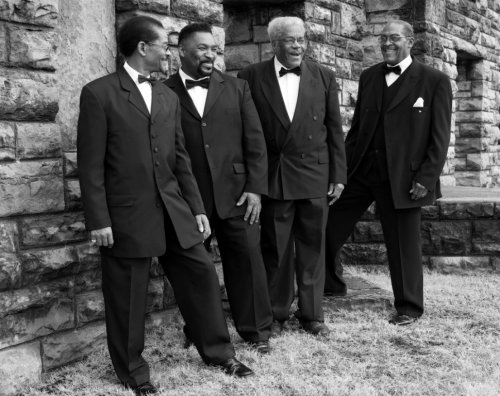
Group.
The Fairfield Four, the most distinguished proponents of traditional African American a cappella gospel singing working today, were organized in 1921 by Reverend J.R. Carrethers, assistant pastor of the Fairfield Baptist Church in Nashville, Tennessee. The group, initially a trio comprised of the Reverend's two sons, baritone Harold and bass Rufus along with tenor lead John Battle, evolved into a quartet with the addition of a second lead, Lattimer Green, later replaced by Samuel McCrary.
The quartet sang a cappella, performing traditional spirituals such as "Ezekiel Saw the Wheel" and "Dry Bones" arranged and taught to them by Reverend Carrethers. In time, the Fairfield Four became professionals with Rufus Carrethers and Samuel McCrary emerging as singers of reputation, Carrethers for his rhythmic style of bass singing, and McCrary for his exceptional clear tenor voice.
The a cappella style of the Fairfield Four was drawn from the Birmingham, Alabama quartet tradition exemplified by recording groups such as the Bessemer Sunset Four, the Birmingham Jubilee Singers, and the Famous Blue Jay Singers with lead vocalist, Silas Steele. The tradition is characterized by a percussive bass voice anchoring middle harmonies sung often on repeated rhythmic syllables ("boom a lanka lanka lanka") and a tenor voice out front carrying the lead.
The Fairfield Four were among pioneers of African American gospel groups that used radio to reach broader audiences. In 1942, they won a contest sponsored by the Colonial Coffee Company, the "prize," their own morning show over 50,000-watt WLAC out of Nashville. Within a few years under the sponsorship of Sunway Vitamins, the group's broadcasts were syndicated to major cities across the United States and they began billing themselves as the "Southland's Famous Fairfield Four."
Radio led to making records and, beginning in 1946, the Fairfield Four released sides on the Bullet, Dot, Delta, and M-G-M labels, and later on Champion, Old Town, and Nashboro. Extending themselves through the far reach of media, the Fairfield Four would influence both sacred and secular vocalists across the land, among them blues singer B.B. King. "Before I left my hometown of Indianola, Mississippi," says King, "the Fairfield Four used to come on the radio every morning real early before we went to work. I became a great fan and, in fact, ...(Sam) McCrary had a lot of influence on my singing over the years, and that's the truth."
In the mid-1940s, the Fairfield Four underwent personnel changes. The Carrethers brothers departed and McCrary assembled a new lineup with baritone James Hill, lead tenor Edward "Preacher" Thomas, utility singer Willie Frank Lewis, and Isaac "Dickie" Freeman, who developed as one of the most important bass vocalists in the genre. "This group," wrote gospel scholar Doug Seroff, "was invincible in 'Battles of Song' with the premier gospel groups in the nation."
The Fairfield Four had a successful run, but then ceased touring in 1950. Hill and Freeman formed a new group, the Skylarks, before retiring completely from professional singing, and McCrary became a church pastor, continuing to perform locally as the Fairfield Four with a revolving lineup of singers.
In 1980, the Fairfield Four reunited to perform at a celebration of pioneering Birmingham quartets. That event sparked a return to the professional arena with a lineup of Reverend Sam McCrary, James Hill, Isaac Freeman, Willie Richardson, Wilson Waters, and Robert Hamlett.
Over the ensuing two decades, the Fairfield Four reached audiences across cultures and worldwide, their tours, recordings, and nationally televised appearances with Lyle Lovett, Elvis Costello, and John Fogerty earning them a broader fan base even larger than in their heyday "golden age" years.
Today, the Fairfield Four are best known from their appearance on the soundtrack and on screen in the Coen Brothers 2000 film, O Brother Where Art Thou. They are multiple Grammy winners with albums including Standing in the Safety Zone (1992) and I Couldn't Hear Nobody Pray (1997) on Warner Brothers, Wreckin' the House (1998) on Dead Reckoning, The Fairfield Four and Friends Live from Mountain Stage (2000) on Blue Plate, and by their bass singer Isaac Freeman with the Bluebloods, Beautiful Stars (2003) on Lost Highway.
Among their awards and honors, the National Endowment for the Arts, National Heritage Award, 1989; Tennessee Lifetime Achievement Award, 1994; Nashville Music Award Lifetime Achievement Award, 1995; James Cleveland Stellar Award, 1996; Grammy Award, Best Traditional Gospel Recording, for I Couldn't Hear Nobody Pray, 1997; Gospel Music Hall of Fame, inducted, 1999.
The Fairfield Four, continuing to perform a cappella, have been singularly important in revitalizing and preserving the oldest style of traditional African American spiritual and gospel singing. Amazingly, the current line-up still maintains its ties to the earliest configuration of the Fairfield Four. Bass singer Isaac Freeman, in the group since the late 1940s, and Robert Hamlett were key figures in the Fairfield Four's reemergence in the 1980s. Joe Rice, the youngest member, came aboard in time for the 1997 Grammy-winning Warner Brothers album, I Couldn't Hear Nobody Pray.
Latest members Ed Hall and Joe Thompson also have longtime associations with the Fairfield Four. Ed Hall, a pioneering African American radio personality, sang starting in the late 1940s with the Fireside Singers, the Fairfield Four's auxiliary "juniors." Joe Thompson, a relative of the Fairfield Four's founding Carrethers brothers, worked with Reverend Sam McCrary's Fairfield Four throughout the 1950s.
--Jerry ZoltenDiscography
Displaying 1-3 of 3 items.
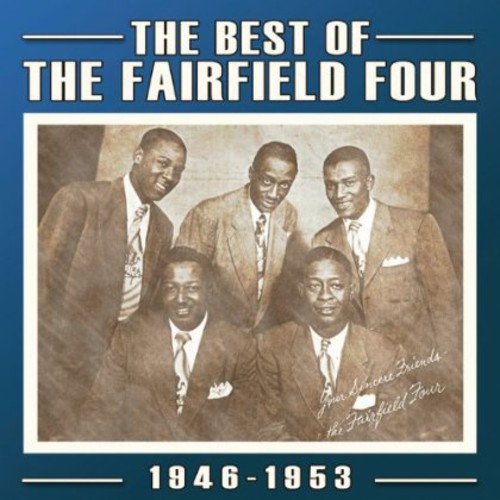
Review: This collection represents selected tracks from their singles released from the start of their recording career in 1946 through to 1953, when there was a significant change in the group's line up with the departure of Rev. Sam McCarary. This is a fine showcase for their distinctive style and represents some of the best and most popular gospel music of that era, which was a heyday for the genre, as with other groups the gospel groups paved the way for the doo wop boom of the 50's. This is classic stuff!
Songlist: Who Stole My Old Shoes, Better Leave That Liar Alone, Don't You Want to Join That Number, Where Shall I Go, Don't Let Nobody Turn You Around, Standing in the Safety Zone, When I Get Up in Heaven, Amazing Grace, Canaan Land, I'm Going to Live the Life I Sing About, You've Got to Move, Just One Moment in God's Kingdom, Dig a Little Deeper in God's Love, Just a Little Talk with Jesus, Lift Him Up, Three of Level, Jesus Met the Woman at the Well, Ezekiel, Roll All Burdens Away, Saviour Don't Pass Me By, In the Wilderness, Let Me Tell You About Jesus, In the Upper Room, I'll Tell the World, Don't Drive Your Children Away, Does Jesus Care, Nobody to Depend On, No Room at the Inn, On My Journey Now, Love Is Like a River, and more

Review: An incredible 14 track set from the legendary gospel group at the peak of their considerable vocal prowess. Recorded in 1989, Nixon Studio, Nashville TN.
Songlist: Hallelujah, I Couldn't Hear Nobody Pray, His Love Is Like a River, Talk to the Man Above, Noah, Walk This Road to Glory, Dig a Little Deeper, Don't Let Nobody Turn You Around, Leaning and Depending, You Can't Beat God Giving, Swing Low, Sweet Chariot, Thank You Jesus, Shadrack, Roll Jordan Roll
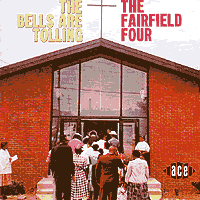
Review: The Four are probably Nashville's best-known, most influential and certainly longest-performing African-American a cappella gospel quartet. 'Bells' is a rare album actually recorded 40 years ago at the Fairfield Missionary Baptist Church in Nashville, Tennessee, and it represents post-war gospel music at its best. Included are: 'The Bells Are Tolling,' 'What Are They Doing In Heaven Today,' 'Memories of My Mother,' 'Every Knee Has Got To Bow,' 'Don't Let Nobody Turn You Around,' 'Wait On The Lord' (aka 'He's My Rock, My Sword, My Shield'), 'I John Saw The Number,' 'In The Old Time Way,' 'At The Gates Of The City,' 'My Work On Earth Will Soon Be Done,' 'I'll Be So Happy' (aka 'If I Could Hear My Mother Pray Again') and 'Hide Me In Thy Bosom.' Powerful, spirited and moving, 'Bells' is African-American gospel at its authentic best!
Songlist: The Bells Are Tolling, What Are They Doing In Heaven Today?, Memories Of My Mother, Every Knee Has Got To Bow, Don't Let Nobody Turn You Around, Wait On The Lord, I John Saw The Number, In The Old Time Way, At The Gates Of The City, My Work On Earth Will Soon Be Done, I'll Be So Happy, Hide Me In Thy Bosom
Gospel Groups | Gospel CDs | Christian Groups | Contemporay Christian CDs
Spirituals CDs | Sacred Harp | Gospel DVDs | Contemporay Christian Christmas
Spirituals Arrangements | Spiritual Solo Songbooks | Gospel Arrangements | Christian Solo Songbooks | Christian Arrangements
Select a Category |
Want to Sing? - Find a Chorus Near You
List of Choruses by State | List of Choruses by City